




When you build a custom off-road rig, it is incredibly easy to get hyper-focused on boosting horsepower, fitting massive mud tires, and installing high-clearance suspension lifts. These are the modifications that give your machine its aggressive stance and jaw-dropping look. But beneath the rugged bodywork and heavy-duty armor, there is a silent backbone to your machine that dictates whether you actually stay on the trail or end up crashed into a tree: your front steering system.
If you are running oversized tires, portal gear lifts, or high-clearance suspension arms on stock steering components, you are putting a massive amount of leverage on weak factory parts. The moment your front wheels wedge against a stubborn rock or slam into a deep, muddy rut at speed, your thin, hollow original equipment manufacturer (OEM) steering rods will bend like wet spaghetti.
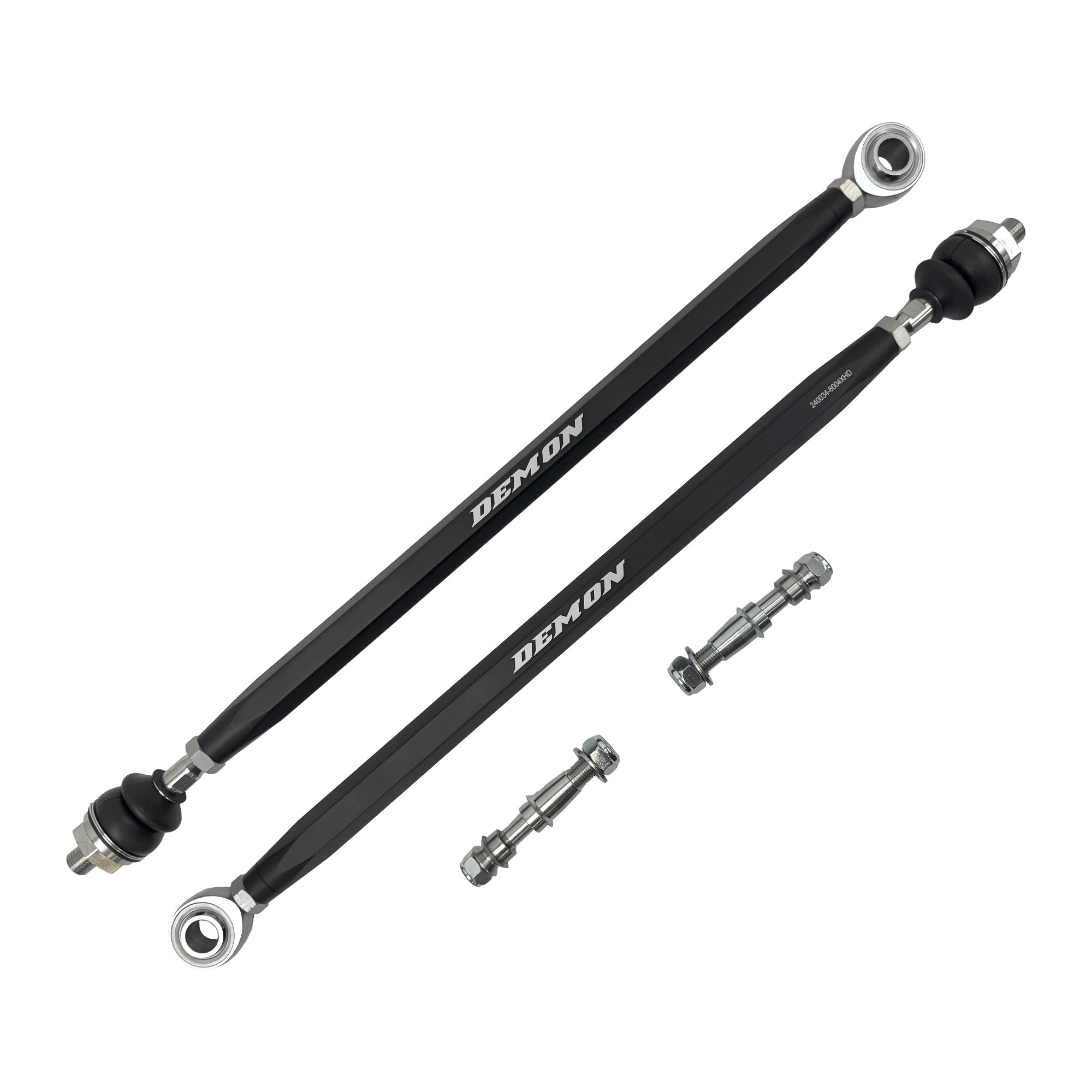
To keep your tires perfectly aligned and your machine tracking straight through the worst terrain imaginable, you need an Xtreme Heavy Duty Tie Rod Race Spec upgrade. This comprehensive guide breaks down exactly what a tie rod actually is, what it does for your steering system, and why your highly modified custom setup absolutely demands a heavy-duty race-spec replacement to survive.
To understand why your steering needs an upgrade, you first have to understand the fundamental physics of how your vehicle turns. Simply put, a tie rod is the crucial structural link that connects your vehicle's central steering gear box (or steering rack and pinion) to the steering knuckles on your front wheels. It is the literal mechanical bridge that transmits every single bit of force from your steering wheel down to the dirt.
When you sit in the driver's seat and turn your steering wheel, that rotational motion travels down the steering column, enters the steering rack, and moves the internal mechanism side-to-side. The tie rods are fastened to each end of this rack. As the rack moves, it forces the tie rods to either push or pull the steering knuckles, forcing the front wheels to point you in your intended direction.
A standard tie rod assembly consists of two main sections: the inner tie rod (which connects to the steering rack inside a protective rubber boot) and the outer tie rod end (which connects directly to the wheel spindle or knuckle). Because these components must move smoothly up and down with your suspension, they utilize pivoting joints at both ends to allow for fluid articulation while under continuous load.
Maintains True Alignment Under Pressure: The primary job of a tie rod is to hold your vehicle's steering alignment specifically the "toe" setting. Proper alignment ensures that both front wheels point perfectly straight forward together. When you slam into boulders, desert whoops, or deep mud holes, a heavy-duty tie rod maintains this precise angle without bowing, keeping your rig stable and tracking predictably.
Eliminates Sloppy Steering Flex: Factory steering rods are notorious for flexing under heavy loads, which introduces a vague, sloppy, and erratic feeling to your steering wheel. An XHD race-spec tie rod remains completely rigid, removing any unwanted deflection and giving you incredibly sharp, immediate, and predictable steering control.
Absorbs Massive Front-End Shock Loads: When a massive, heavy tire hits an obstacle at high speed, thousands of pounds of impact force travel instantly up the drivetrain. An upgraded tie rod acts as the frontline shield for your front end, absorbing these brutal shock loads without snapping, bending, or tearing loose from the wheel knuckle.
Many riders ask: "If factory tie rods are so important, why are they so weak out of the box?" The truth is that factory tie rods are deliberately designed by OEM engineers to act as a mechanical "fuse" or engineered weak point. The logic is simple: if a stock machine hits a massive rock, the manufacturer wants the cheap, easily replaceable tie rod to bend first, thereby absorbing the impact and protecting the incredibly expensive internal gears of the steering rack.
While that philosophy works perfectly fine for a bone-stock machine driving slowly on flat, well-groomed dirt roads, it becomes a massive liability the second you modify your vehicle.

When you install a lift kit, widen your track width, or bolt on heavy, oversized mud tires, you drastically increase the rotational mass, unsprung weight, and leverage acting against your steering system. Every time your larger tires claw for traction, they exert exponentially more force on the steering links than the factory ever anticipated. If you try to run a custom setup with factory steering rods, the "fuse" will blow almost immediately leaving you stranded with a broken machine miles away from civilization.
An Xtreme Heavy Duty Tie Rod Race Spec upgrade completely re-engineers this vulnerable weak point. Instead of thin, stamped mild steel, these upgraded steering components are CNC-machined from solid aircraft-grade 6061-T6 aluminum or constructed from thick-walled 4340 chromoly steel.
Furthermore, they completely eliminate weak, small factory ball joints. Instead, race-spec tie rods utilize massive, heat-treated chromoly heim joints (spherical bearings) with precision-machined misalignment spacers. This structural overhaul completely changes your front-end steering system from a fragile, nerve-wracking liability into a bulletproof, race-ready asset that gives you full confidence to hammer the throttle through the most punishing terrain.
Leave a comment