




Every rider reaches a point where stock parts stop matching the machine.
It usually does not happen after one modification. It happens after several. Bigger tires, upgraded A-Arms, a lift kit, more suspension travel, or simply riding harder than before all change how your ATV or UTV performs. Those upgrades make the machine more capable, but they also ask more from the components working underneath.
That is where many riders start asking the wrong question.
Instead of asking, "Which ball joint is stronger?" the better question is, "Which ball joint actually matches my build?"
Because the right ball joint is not determined by the catalog. It is determined by the machine you built.

Most riders look at tires before they look at suspension.
That makes sense because tires are easy to see. A-Arms are not.
But every time your suspension moves, your A-Arms and ball joints are carrying the load that keeps your wheels exactly where they should be. As the suspension works harder, the ball joints work harder too.
Your suspension never forgets how you ride.
If your ATV or UTV still has factory A-Arms or only mild suspension upgrades, the load placed on the ball joints stays much closer to what the manufacturer originally designed.
Once aftermarket A-Arms, longer suspension travel, or larger tires become part of the build, the forces acting on the ball joints increase dramatically.
That is why your A-Arms often tell you which upgrade makes the most sense long before a worn ball joint does.
Not every upgraded machine needs the biggest ball joint available.
Many riders believe stronger always means better, but that usually leads to spending money where it is not necessary.
A machine with moderate upgrades still benefits from stronger components, just not always race-level components.

If your build includes slightly larger tires, trail riding, weekend adventures, utility work, or light suspension modifications, Heavy Duty Ball Joints are often the better match. They provide more strength than stock while keeping the suspension balanced with the rest of the machine.
Heavy Duty Ball Joints are commonly a great fit for riders who have:
The goal is not making one component stronger than everything else.
The goal is making every suspension component work together.
There comes a point where a machine stops being a weekend trail build.
Long travel suspension, aftermarket A-Arms, aggressive riding, deeper mud, and oversized tires all increase the amount of force moving through the suspension. Those upgrades improve capability, but they also create more stress every time the wheels move.
A fully upgraded machine deserves suspension components that can keep up.
That is where XHD Ball Joint Race Spec becomes the smarter choice.
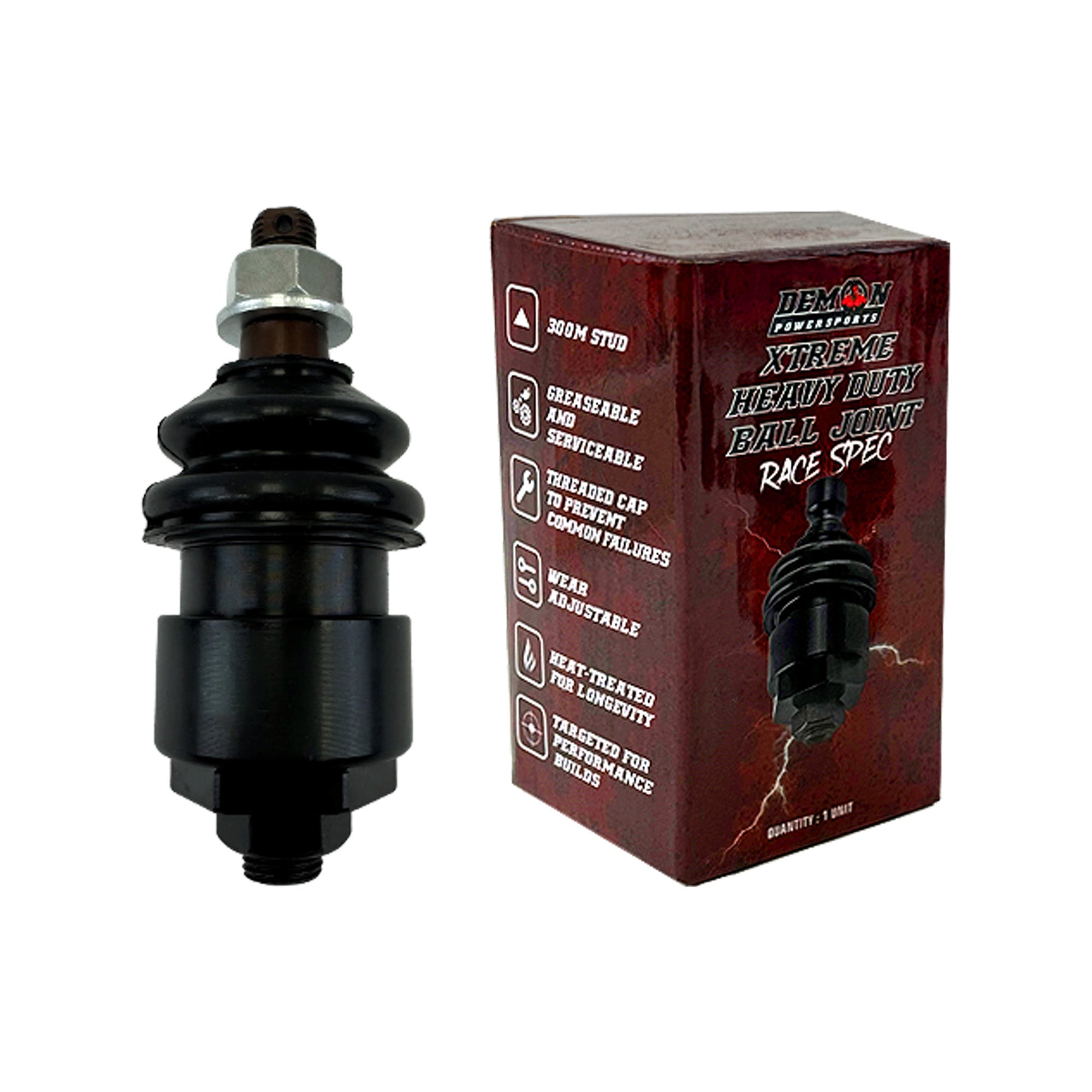
These builds ask more from every steering and suspension component. The ball joints experience more movement, higher impact loads, and greater steering forces than a moderately upgraded machine.
If the rest of the suspension keeps evolving, the ball joints should evolve with it.
Choosing XHD Race Spec is not about preparing for failure.
It is about making sure the suspension stays as capable as everything else you upgraded.
Most riders install larger ATV or UTV tires because they want more traction and better obstacle clearance.
That is exactly what happens.
But larger tires also create more leverage. Every turn, every bump, and every rough landing places additional force through the steering knuckle, A-Arms, and ball joints.
The machine feels the extra weight long before the rider does.
This is why two machines with the same model can need completely different ball joints.
A stock Polaris Ranger used for property maintenance has very different suspension demands than a Polaris RZR running oversized tires and aftermarket A-Arms.
The same applies to Can-Am Defender, Honda Pioneer, Yamaha Wolverine, Kawasaki Teryx, and CFMOTO UForce builds.
The suspension should always reflect the way the machine is actually being used.
One of the biggest mistakes riders make is upgrading parts individually without thinking about how they work together.
A stronger axle helps when the axle matches the load.
A lift kit performs better when the suspension supports it.
The same idea applies to ball joints.
The strongest machines are rarely the ones with the most expensive parts.
They are the ones where every component supports the next.
When choosing between HD Ball Joints and XHD Ball Joint Race Spec, think about the complete build instead of one individual part.
Those pieces already tell you which direction to go. The ball joint should simply match the machine they created.
Every upgrade changes expectations.
More traction creates more load.
More suspension travel creates more movement.
More capability creates more responsibility for the components underneath.
That is why there is no single "best" ball joint.
For many riders, Heavy Duty Ball Joints are exactly what the machine needs because the build still stays close to factory geometry with moderate improvements.
For fully upgraded machines running aftermarket A-Arms, long travel suspension, oversized tires, and aggressive riding, XHD Ball Joint Race Spec becomes the better long-term solution because it matches the demands of the build.
The smartest upgrade is rarely the biggest one.
It is the one that keeps every part of the suspension working together, so the machine feels balanced every time the trail gets rough.
Leave a comment