





There is a moment when a Can-Am stops feeling like a recreational machine and starts feeling like something built for punishment.
Maybe it happens when you add larger tires. Maybe it happens after a lift kit and suspension upgrades. Or perhaps it happens when you stop taking the easy line and start looking for the rocks, mud holes, steep climbs, and rough terrain that make a ride worth remembering.
The engine has the power. The tires have the grip. The suspension is ready to move.
But underneath all of it, one question remains: How much can your axles take?
Off-road riding rarely happens according to plan.
You approach an obstacle expecting one wheel to climb over it, but the terrain catches the opposite tire instead. You add throttle to get through a mud hole, climb a steep section, or crawl over a rock. Suddenly, the drivetrain is dealing with a combination of torque, traction, suspension movement, and resistance from the terrain.
That is when an axle earns its keep.
An axle doesn't simply transfer power from the drivetrain to the wheels. It has to do that while the suspension is moving and the vehicle is being pushed through terrain that constantly changes the loads acting on the machine.
Can-Am's own engineering information describes axles as components that handle extreme loads while working with the vehicle's drivetrain, steering, and suspension geometry.

A stock Can-Am and a heavily modified Can-Am may look like the same machine, but they don't necessarily experience the trail in the same way.
Larger tires can change the forces moving through the drivetrain. A lift kit can alter suspension geometry and operating angles. Increased suspension travel can create more movement. Add aggressive driving and difficult terrain, and the drivetrain can experience conditions far beyond an easy trail ride.
None of this means a factory axle is automatically going to fail when you modify your Can-Am.
It means you should start looking at the machine as a complete system.
When you increase capability in one area, the components connected to it deserve consideration too.
Here's the strange thing about off-road driving: traction can be both your best friend and one of the biggest challenges for your drivetrain.
When the tires spin freely, some energy is lost through wheel slip. When they suddenly find solid ground, the drivetrain can experience a very different load.
Now imagine that happening while climbing a rock, powering through mud, or trying to pull the machine over an obstacle.
The rider may only notice that the Can-Am suddenly hooks up and moves forward.
The drivetrain experiences something much more complicated.
That is why serious riders don't only ask how much horsepower their machine produces. They also think about how that power is being transferred to the ground.
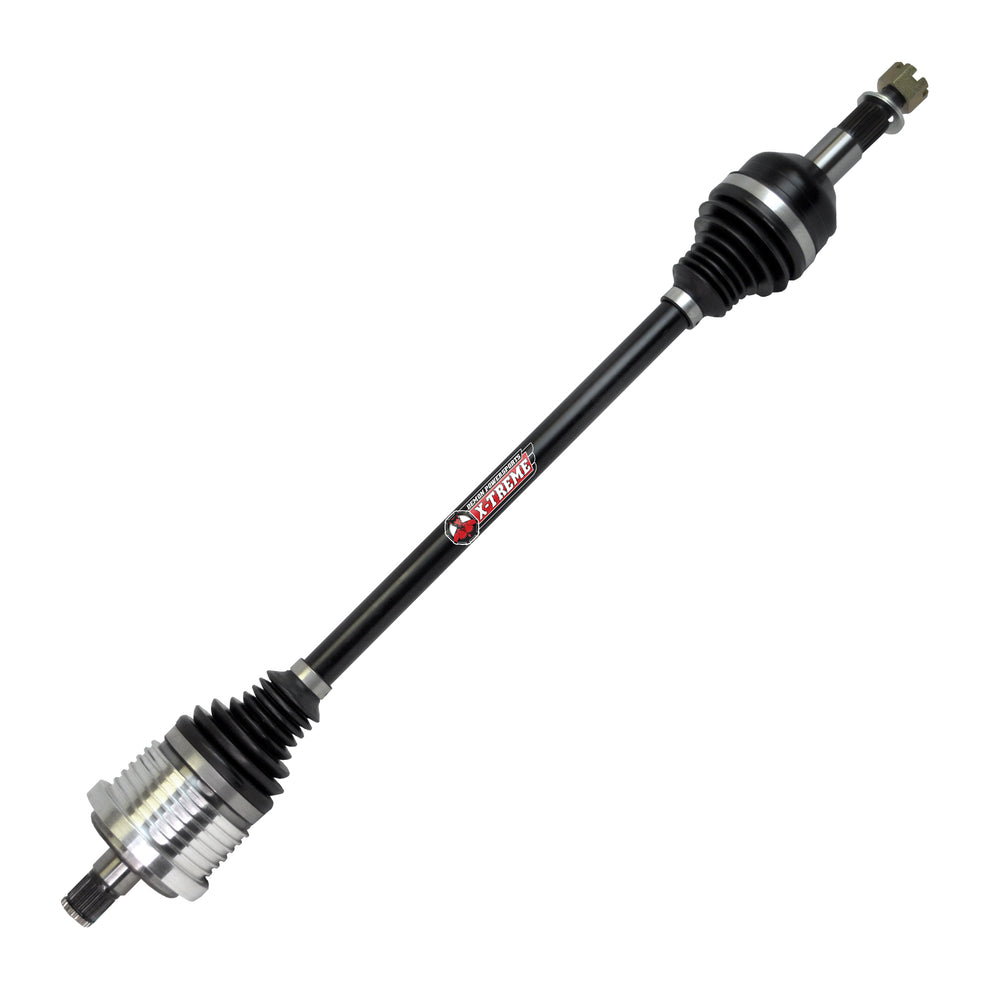
For riders who regularly push their Can-Am into demanding terrain or have built their machine around larger tires, suspension upgrades, or aggressive performance, Can-Am Xtreme Heavy Duty Axles become a logical part of the conversation.
The purpose of a heavy-duty axle isn't simply to give a modified machine a tougher-looking component.
It is about choosing drivetrain components that make sense for the demands placed on the vehicle.
An XHD axle can become particularly relevant when the machine is no longer being used like a stock recreational vehicle and the rider is consistently asking more from the drivetrain.
Most riders think about performance in terms of horsepower, suspension travel, tire size, and ground clearance.
Those things are exciting because you can see and feel the difference immediately.
Drivetrain strength is different.
You don't normally think about the axle when everything is working correctly. You think about it when you're halfway through a difficult trail and something goes wrong.
That is why drivetrain preparation is less about predicting exactly when a component will fail and more about understanding the demands you're placing on the vehicle.
If your Can-Am spends most of its life on easy trails, your requirements are different.
If it spends weekends climbing rocks, attacking mud, running larger tires, or exploring terrain where every obstacle demands more throttle, the conversation changes.
There is no magic number that tells you exactly when a factory axle has reached its limit.
The better question is how you use the machine.
If the answer to several of those questions is yes, it may be time to look beyond the factory configuration and consider whether your drivetrain is built for the way you actually ride.
Because the strongest Can-Am isn't necessarily the one with the most horsepower.
It's the one where every major component is prepared for what the rider plans to do with it.
Leave a comment