





You’re pinned at wide-open throttle, carving up massive dune bowls or blasting through endless desert washboards. The engine is screaming, the turbo is whistling, and the adrenaline is pumping. But while you’re having the ride of your life, an invisible battle is raging right behind your front bumper. Forced-induction horsepower creates an absolute furnace under the hood. To keep that high-output monster running at peak performance, your radiator needs an unrelenting stream of cold, dense air. Yet, standing directly in front of your primary line of thermal defense is a restrictive piece of factory plastic. Upgrading to an aftermarket high-flow front grille isn't just a cosmetic makeover, it’s the ultimate life-support system for your turbo cooling loop.
When you step on the gas in a turbocharged side-by-side, you aren't just feeding air to the cylinders you're packing in compressed, scorching thermal energy. Every pound of boost spikes internal engine temperatures, placing a massive burden on your coolant, intercooler, and oil heat exchangers. The moment you push through deep sand, conquer sticky mud, or pull up a steep mountain grade, heat levels skyrocket in seconds.

At high speeds, you might assume there’s plenty of air jamming into the front end. However, at lower speeds like crawling technical rock gardens or picking a line through tight, brush-heavy woods natural ram-air pressure drops significantly. Without constant, unobstructed airflow penetrating deep into the radiator core, thermal energy builds up faster than the electric cooling fan can pull it out.
If you take a close look at the stock grilles on a Polaris RZR Turbo, you’ll quickly spot the design flaw. Factory grilles are engineered around low-cost mass production and timid aesthetic choices, not extreme thermal efficiency. They feature thick, chunky plastic slats, overly restrictive patterns, and tight outer borders that restrict air movement right where your cooling fins need it most.
Instead of channeling incoming air smoothly into the radiator fins, these solid plastic bars act like a brick wall. Incoming draft slams into the flat plastic surfaces, creating localized air turbulence and boundary-layer separation. Instead of sliding cleanly through the radiator matrix, a high percentage of ambient air gets bounced outward around the front fascia. Your engine ends up starving for fresh air right when it’s working its absolute hardest.
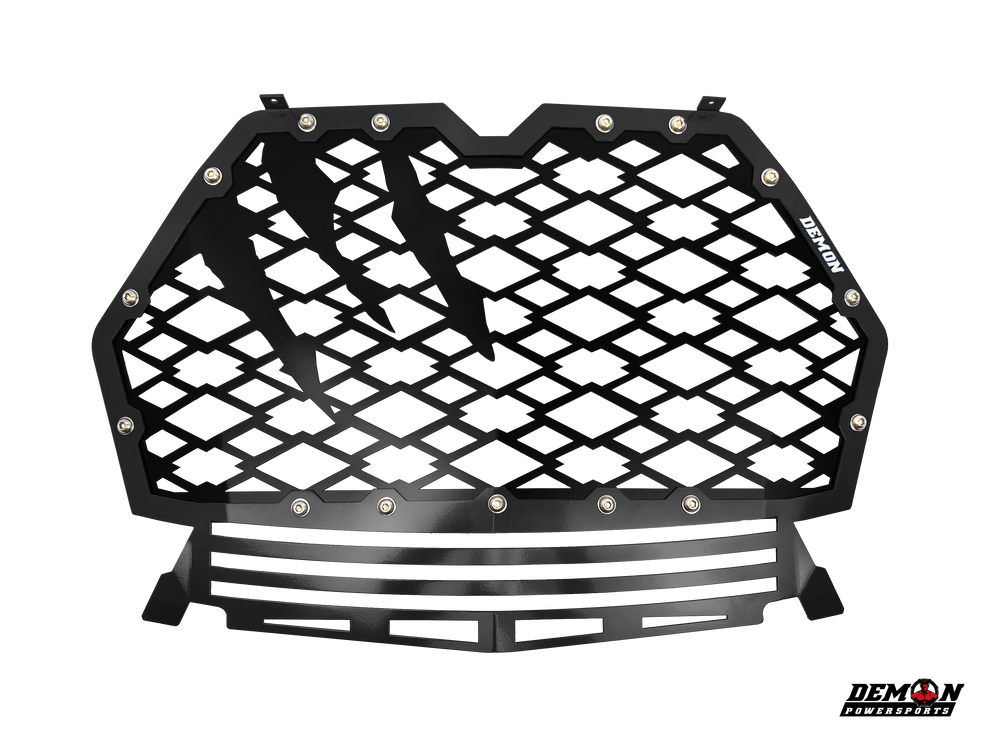
Swap out that solid factory plastic for a high-flow Demon Powersports Heavy Duty Grille, and the entire thermodynamic equation shifts in your favor. Precision-engineered from CNC laser-cut aluminum or heavy-duty steel mesh, high-flow grilles optimize the surface-area-to-open-space ratio to maximize cooling productivity.
Maximized Surface Permeability: By replacing thick plastic louvers with tight honeycomb or diamond-mesh patterns, net open airflow area increases dramatically often by as much as 30 percent or more.
Smooth Ram-Air Channeling: The thin, rigid profile of metal mesh slices through incoming air rather than deflecting it. This reduces front-end turbulence and drives clean, linear draft across the entire surface of the radiator core.
Rapid Thermal Exchange: More cubic feet per minute (CFM) of air rushing across the cooling fins means hot engine coolant drops in temperature much faster, keeping your intercooler charged and your boost air dense.
Nothing ruins an epic weekend trip faster than your dash popping an over-temp warning light and dropping your UTV straight into "limp mode." Modern ECU safety algorithms are completely unforgiving. The moment coolant temperatures cross critical safety thresholds, the computer pulls ignition timing and cuts boost pressure to protect the motor from catastrophic failure. You're instantly left limping back to staging while your buddies ride off into the dust.
Overheating usually stems from heat soak, a nightmare scenario where your cooling loop gets so saturated with thermal energy that it can no longer recover while the vehicle is in motion. A high-flow front heavy duty grille provides the continuous, high-volume air draft required to dissipate heat in real time, locking your operating temperatures squarely in the sweet spot (typically 180°F to 205°F). You get consistent horsepower from sunrise to sunset without thermal rollback ruining the fun.
Some riders worry that opening up the grille pattern leaves fragile aluminum radiator fins exposed to aggressive trail hazards. After all, trailing behind another machine means dodging a relentless barrage of flying gravel, sharp rocks, and heavy roost.
Fortunately, high-performance grilles don't force you to choose between cooling efficiency and front-end armor. Demon Powersports Grilles are crafted from high-tensile steel or heavy-gauge powder-coated aluminum. The precision-engineered mesh spacing is tight enough to stop flying debris, sticks, and rocks cold, while remaining porous enough to let air pass freely. You get heavy-duty front-end protection that can take a beating on the trail without choking your engine's air supply.
Upgrading your Polaris RZR Turbo with a high-flow front grille transforms a passive plastic exterior panel into an active cooling component. By opening up the airflow channels, eliminating front-end air turbulence, and armor-plating your radiator against trail hazards, you ensure your machine stays cool, stays fast, and stays running strong no matter how hard you push it.
Leave a comment