





You’re trapped halfway up a brutal rock waterfall, engine screaming at 7,000 RPM, tires hunting for traction. Suddenly - SNAP! A sound like a gunshot echoes through the canyon, your driver-side wheel drops dead, and your epic weekend instantly turns into a grueling six-hour tow-strap nightmare.
If you’re sick of feeding low-grade factory axles to the trail gods, it’s time to step up to a bulletproof setup like the Polaris XHD Axle Race Spec. But before you hit "Add to Cart," there’s one golden rule every off-roader needs to respect: measure twice, order once.
Guessing your axle dimensions is a fast track to mechanical carnage. Order a shaft that’s an inch too long, and your differential seals will disintegrate the first time your suspension hits hard bump. Go too short, and you’ll yank the inner CV cage clean out of its housing on the first big air landing.
Grab your shop towels, clear the workbench, and let's make sure your new race-grade driveline drops in like a glove.
Before pulling out the tape measure, yank the old axle off your machine and strip away the trail grime. You’ll need a standard tape measure, digital calipers, a paint pen, and a can of brake cleaner. Lay the axle completely flat on a clean workbench so it isn't binding under its own weight.
The compressed measurement tells you how short the axle gets when your shocks slam into the bump stops.
Collapse the axle completely by pushing both the inner (differential side) and outer (wheel hub side) CV joints inward toward the center shaft until internal components bottom out.
Measure from the inner shoulder of the differential stub shaft straight across to the outer shoulder of the wheel hub spindle.
The Golden Rule: Ignore the threaded spindle tip and snap-ring grooves! You are measuring structural shoulder-to-shoulder length only.
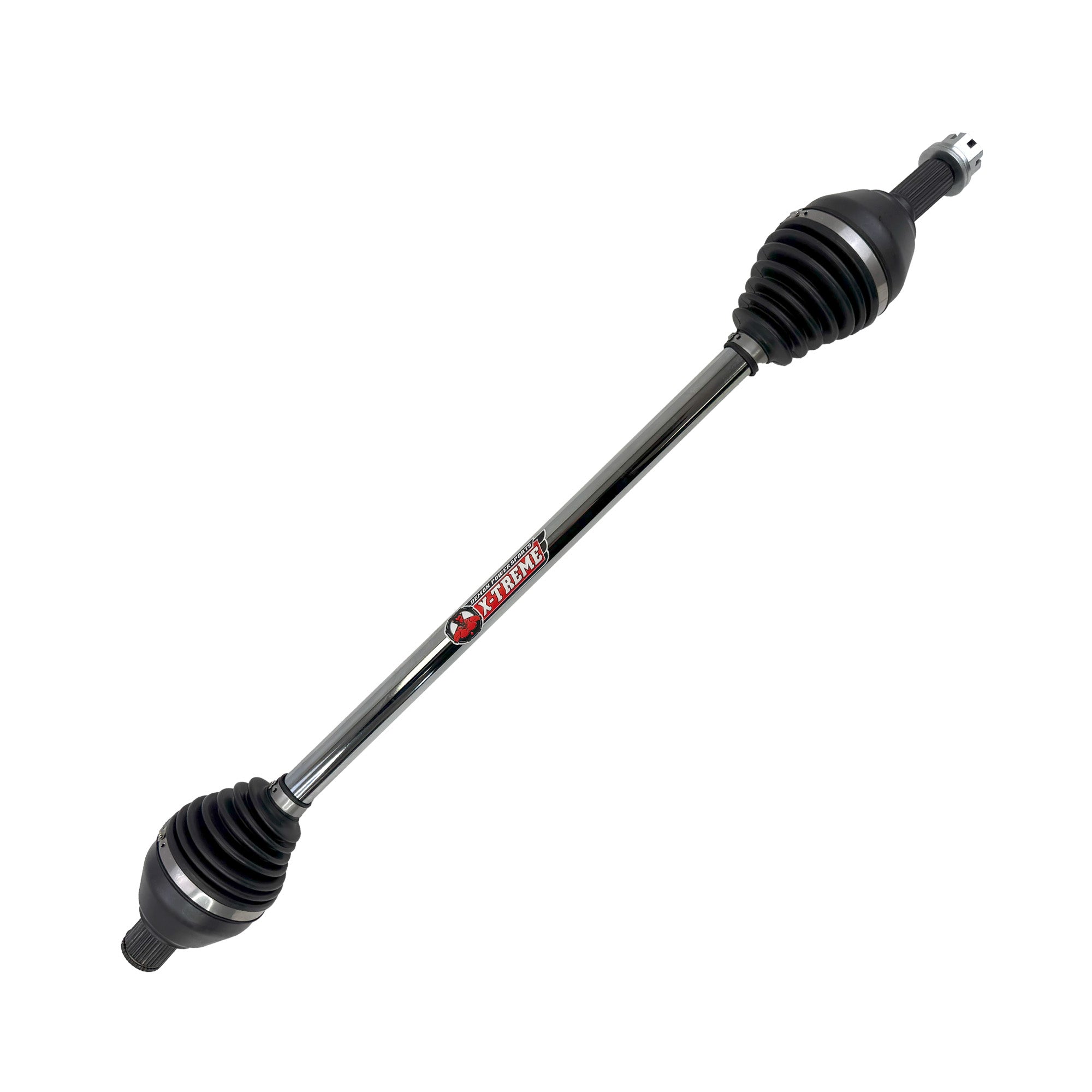
Now it’s time to stretch things out to see how the axle behaves when your suspension hangs at full droop over deep whoops.
Pull both CV joints firmly outward until the internal cages reach maximum extension.
Measure between the exact same inner and outer shoulder points you used in Step 2.
Calculate Your Plunge Window: Subtract your compressed length from your extended length. That leftover number is your axle’s total travel window—the operational stroke your driveline requires to handle full wheel travel without binding.
Here’s a dirty secret of off-road manufacturing: OEMs love shifting spline counts between model years, trim packages, and differential options. A single extra tooth means your shiny new axle becomes an expensive paperweight.
Blast the stub shafts clean with brake cleaner.
Dab your starting tooth with a bright paint pen so you don't end up counting in circles.
Count every single tooth on the differential side, then repeat the process for the outer hub side.
Fire up your digital calipers and measure the outer diameter (OD) across the spline teeth to confirm shaft thickness down to the millimeter.
Stock axles usually call it quits around 35 degrees of angle. If you run aftermarket A-arms, bracket lifts, or long-travel kits, your CV joints operate in a whole new dimension of stress.
Upgrading to the Polaris XHD Axle Race Spec gives you re-engineered high-articulation CV cages built to handle extreme angles up to 47 degrees without binding. But to take full advantage of that clearance, double-check your frame-to-hub distance directly on the vehicle at full droop, static ride height, and full compression.
Taking ten extra minutes at the bench is all it takes to guarantee your Polaris XHD Axle Race Spec bolts up flawlessly on the very first try. Armed with dual heat-treated 4340 chromoly shafts, 300M alloy internals, and 20% to 30% larger CV cages, these axles are built to turn giant tires and absorb violent shock loads without flinching. Measure smart, bolt 'em up tight, and get back out there to conquer the worst trails on the map!
Leave a comment